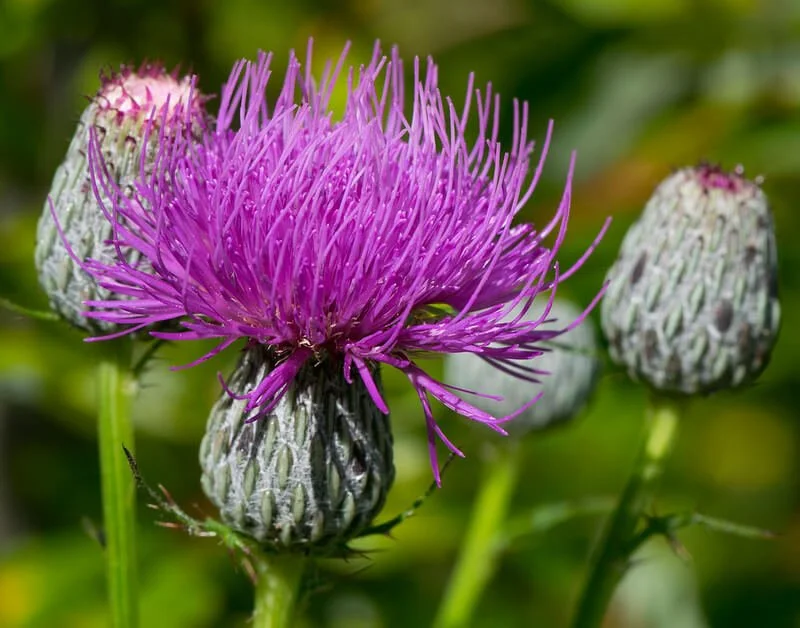
Swamp Thistle (Cirsium muticum)

$5.00

The flowers of Swamp Thistle attract a wide variety of insects, particularly native bees, butterflies, and skippers (illinoiswildflowers.info). It serves as a host plant for 14 species of butterflies and moths, as well as 20 species of specialist bees (Johnson and Colla, 2023). Swamp Thistle is also an important plant for conservation, benefiting the endangered Rusty-patched bumblebee (Bombus affinis) (mnfi.anr.msu.edu) and the endangered Swamp Metalmark (Calephelis muticum) (mnfi.anr.msu.edu). Small songbirds may eat the seeds of thistles, especially the American Goldfinch, which also uses the soft hair tufts from thistle seeds to build its nest (illinoiswildflowers.info). Mammalian herbivores typically avoid Swamp Thistle due to its spiny leaves and preference for wetland habitats.

Photo credit: Joshua Mayer

The flowers of Swamp Thistle attract a wide variety of insects, particularly native bees, butterflies, and skippers (illinoiswildflowers.info). It serves as a host plant for 14 species of butterflies and moths, as well as 20 species of specialist bees (Johnson and Colla, 2023). Swamp Thistle is also an important plant for conservation, benefiting the endangered Rusty-patched bumblebee (Bombus affinis) (mnfi.anr.msu.edu) and the endangered Swamp Metalmark (Calephelis muticum) (mnfi.anr.msu.edu). Small songbirds may eat the seeds of thistles, especially the American Goldfinch, which also uses the soft hair tufts from thistle seeds to build its nest (illinoiswildflowers.info). Mammalian herbivores typically avoid Swamp Thistle due to its spiny leaves and preference for wetland habitats.

Photo credit: Joshua Mayer

Life Cycle: Biennial

Sun Exposure: Full-Partial

Soil Moisture: Wet--Medium/wet

Height: 3-7 feet

Bloom Time: July-October

Bloom Color: Purple

Advantages: Pollinator Favorite, Bird Favorite, Deer Resistant, Rain Garden

Host Plant: Swamp Metalmark, Painted Lady and 12 other species of butterflies and moths use this as a caterpillar host plant in our area (Johnson and Colla, 2023)

Specialist Bee: Andrena apacheorum, A. runcinatae, Osmia chalybea, Melissodes agilis, M. boltoniae, M. coloradensis, M. confusus, M. coreopsis, M. desponsus, M. illatus, M. microstictus, M. rivalis, M. subillatus, Svastra obliqua, Megachile inimica, Megachile pugnata, Osmia chalybea, O. coloradensis, O. subaustralis and O. texana (Johnson and Colla, 2023)

Beneficial for Endangered or Threatened Species: Rusty-patched bumble bee (Bombus affinis) (mnfi.anr.msu.edu), Swamp metalmark (Calephelis muticum) (mnfi.anr.msu.edu)

Resource: Johnson, Lorraine, and Sheila Colla. A Northern Gardener’s Guide to Native Plants and Pollinators: Creating Habitat in the Northeast, Great Lakes, and Upper Midwest. Island Press, 2023